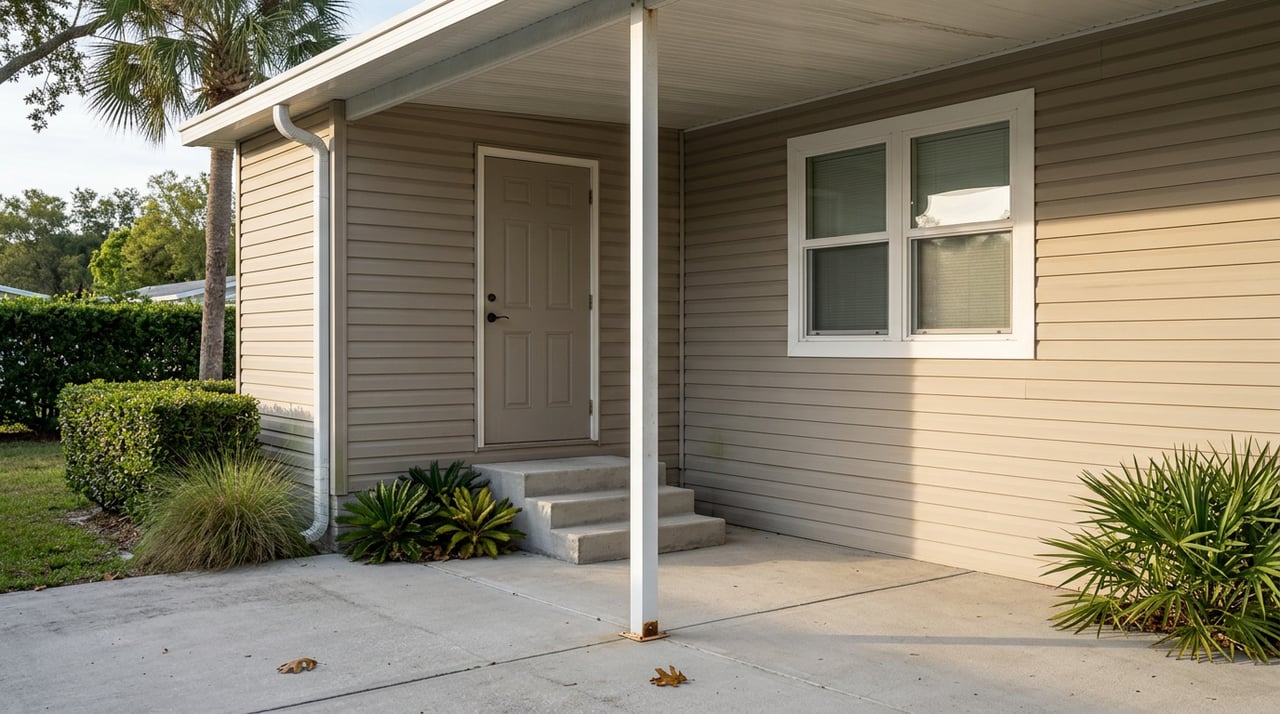
Picture two manufactured homes in Homosassa, same age, same square footage, same asking price, sitting half a mile apart. One could close in a matter of weeks to a buyer with a conventional mortgage. The other might sit on the market for months, draw cash offers only, and close with a trip to the county tax office instead of a title company. The homes could look identical from the street. The difference would come down to paperwork almost nobody checks before they list: whether that home has ever been converted from a vehicle title to a deed.
In Florida, a manufactured home is born as a titled vehicle. The state issues it a certificate of title through the Department of Highway Safety and Motor Vehicles, the same agency that titles cars and boats. That home stays a vehicle on paper, no matter how permanent it looks on the ground, until someone completes a specific conversion process and the county issues a decal with two letters on it: RP, for real property. Until that happens, the home cannot be sold the way most sellers assume it will be sold, and that single fact shapes almost everything else about a Homosassa manufactured home sale, from who can finance it to which office processes the paperwork at closing.
Who Owns the Ground Decides the Whole Sale
The first question that determines a manufactured home's fate in Homosassa has nothing to do with the home itself. It's about the dirt underneath it.
If the home sits on land the owner owns outright, converting to real property is possible. If it sits on a leased lot inside a land-lease community, conversion is not an option at all, no matter how long the owner has lived there or how nicely the home has been kept up.
Homosassa has a meaningful concentration of land-lease communities. Stonebrook, Forest View, and Walden Woods, all part of Sun Communities' portfolio in the area, lease the lot to the resident while the resident owns the home itself. That structure works well for affordability and lifestyle, with clubhouses, fishing ponds, and organized activities that draw retirees to the area. But it also means a home in one of these communities will always be personal property under Florida law. It will never carry a deed. It sells the way a car sells: title endorsed by the seller, new title issued to the buyer, transaction processed at the tax collector's office rather than a title company.
A manufactured home on an individually owned parcel, the kind scattered across Homosassa's more rural roads and larger lots, has a different path available. If the owner also owns the land beneath the home, that owner can pursue conversion to real property and eventually list the home the way a site-built house gets listed, with a deed and a standard purchase contract.
Same style of home. Two entirely different sales processes, decided entirely by land tenure.
From Vehicle Title to Deed: What Conversion Actually Involves
For sellers who do own their land, the path from vehicle title to deed runs through two Citrus County offices and one state agency, in a specific order:
- Confirm the home is permanently affixed to the land, with wheels and axles removed. A home still capable of being towed doesn't qualify.
- Resolve any liens showing on the existing DMV-issued certificate of title. A lienholder has to release its interest before the process can move forward.
- File a Declaration of Mobile Home as Real Property with the Citrus County Property Appraiser's office. This is the standard state form, DR-402, used in every Florida county for this exact purpose.
- Take the approved declaration to the Citrus County Tax Collector and obtain the Real Property decal. This step has to happen before the title can be retired. No RP decal, no retirement.
- Record the certificate of title, any lien satisfaction, and a legal description of the property with the Clerk of the Circuit Court.
- Submit the retirement application, along with the required FLHSMV form and supporting documents, to the state.
Once the state approves retirement, the vehicle title is cancelled for good. Every future sale of that home happens by deed, recorded in the public record like any other piece of Homosassa real estate.
Skip this and the home stays personal property indefinitely, even if it sits on land the owner has held for decades. Plenty of Homosassa sellers discover this only when a buyer's lender asks for a deed that doesn't exist.
Why the Financing Math Changes Overnight
The retirement status of a manufactured home doesn't just determine which office processes the paperwork. It determines who can afford to buy it.
Before retirement, the home and the land are two separate legal things, even if the same person owns both. Most mortgage lenders won't write a conventional loan against a home that's still classified as a vehicle, because there's no deed to secure against. Title insurance, when it's available at all, typically covers the land only, leaving the structure itself outside the policy. Buyers in this situation are left with cash, a chattel loan written against the home the way a boat loan is written against a boat, or seller financing.
After retirement, the calculus flips. The home becomes part of the real estate. A conventional mortgage becomes possible. Full title insurance becomes possible. And because the home is now assessed as real property rather than tangible personal property, the owner becomes eligible to file for homestead exemption on it, something a personal-property manufactured home cannot claim no matter how long someone has lived in it as a primary residence.
That eligibility shift matters to a seller's asking price story too. A retired-title home with homestead exemption already on file gives a buyer a clearer sense of what their tax bill will look like on day one. A personal-property home carries none of that history, because it was never assessed that way to begin with.
There's a second financing wrinkle worth knowing regardless of land status. Homes built before 1976, when the HUD Code for manufactured housing took effect, are harder to finance under any classification. Lenders view pre-HUD-Code construction as a different risk category entirely, and that age cutoff sits outside anything the retirement paperwork can fix.
What This Looks Like Park by Park
The practical difference between a land-lease community and owned land shows up at every stage of a Homosassa sale:
In a land-lease community such as Stonebrook, Forest View, or Walden Woods, the home always sells as personal property. The transaction closes with a bill of sale and title transfer at the tax collector's office, not a deed at a title company. Because Florida treats an unretired personal-property sale similarly to a vehicle transaction, a standard real estate license alone doesn't cover it unless the sale includes land, which a leased lot by definition doesn't. The buyer pool skews toward cash and chattel financing. Homestead exemption isn't available on the home. None of this reflects poorly on the community. It reflects the legal structure of a leased lot, and it's the same structure every resident in that park is working within.
On owned land where the title has been retired, the sale looks like any other Homosassa home sale. A deed changes hands. A standard purchase contract applies. Conventional financing is on the table, which widens the buyer pool considerably compared to a cash-only market.
On owned land where the title has never been retired, the seller has a choice to make before listing, not after an offer comes in. Complete the retirement process ahead of time and open the door to conventional buyers, or list as-is and accept the narrower, cash-and-chattel buyer pool that comes with personal-property status.
Before You List, Find Out What You're Actually Selling
The single most useful thing a Homosassa manufactured home seller can do before contacting anyone about a sale is confirm the classification status with the Citrus County Tax Collector's office. That single phone call or visit answers the question that determines everything downstream: is this home already real property, is it eligible to become real property, or is it permanently locked into personal-property status because of a land lease.
For sellers on owned land who haven't retired the title, starting that process weeks or months before listing, rather than after an offer arrives, avoids the scramble of trying to finish a multi-agency paperwork chain during a financing contingency deadline. For sellers in a land-lease community, the smarter move is pricing and marketing the home from day one as the personal-property sale it will always be, with financing expectations set clearly for prospective buyers up front.
A Few Questions Worth Asking Before You List
Can I still sell my home if I'm in a community like Stonebrook or Walden Woods? Yes. It sells as personal property through a title transfer at the tax collector's office rather than a deed. Most buyers in this situation pay cash or use a chattel loan, so plan your marketing and pricing with that buyer pool in mind.
How long does title retirement take once I start the process? It depends on how quickly liens get resolved and documents get recorded, since multiple offices are involved in sequence. The safest approach is to start well before you plan to list rather than after you're already under contract.
Does retiring the title change my taxes? Yes. A retired-title home moves from tangible personal property tax to standard real estate ad valorem tax, and it becomes eligible for homestead exemption if it's your primary residence, something a personal-property manufactured home cannot claim.
Manufactured home sales in Homosassa reward sellers who do the paperwork homework early, and that's exactly the kind of groundwork That Other Laura Bush walks clients through before a home ever hits the market. Whether your home sits on a leased lot or land you own outright, knowing your classification before you list means no surprises when a buyer's lender starts asking questions. Get Your Home Valuation and let's map out exactly what your sale will look like from the first call.